Complete Mold Remediation Guide for Eagle Mountain Homeowners
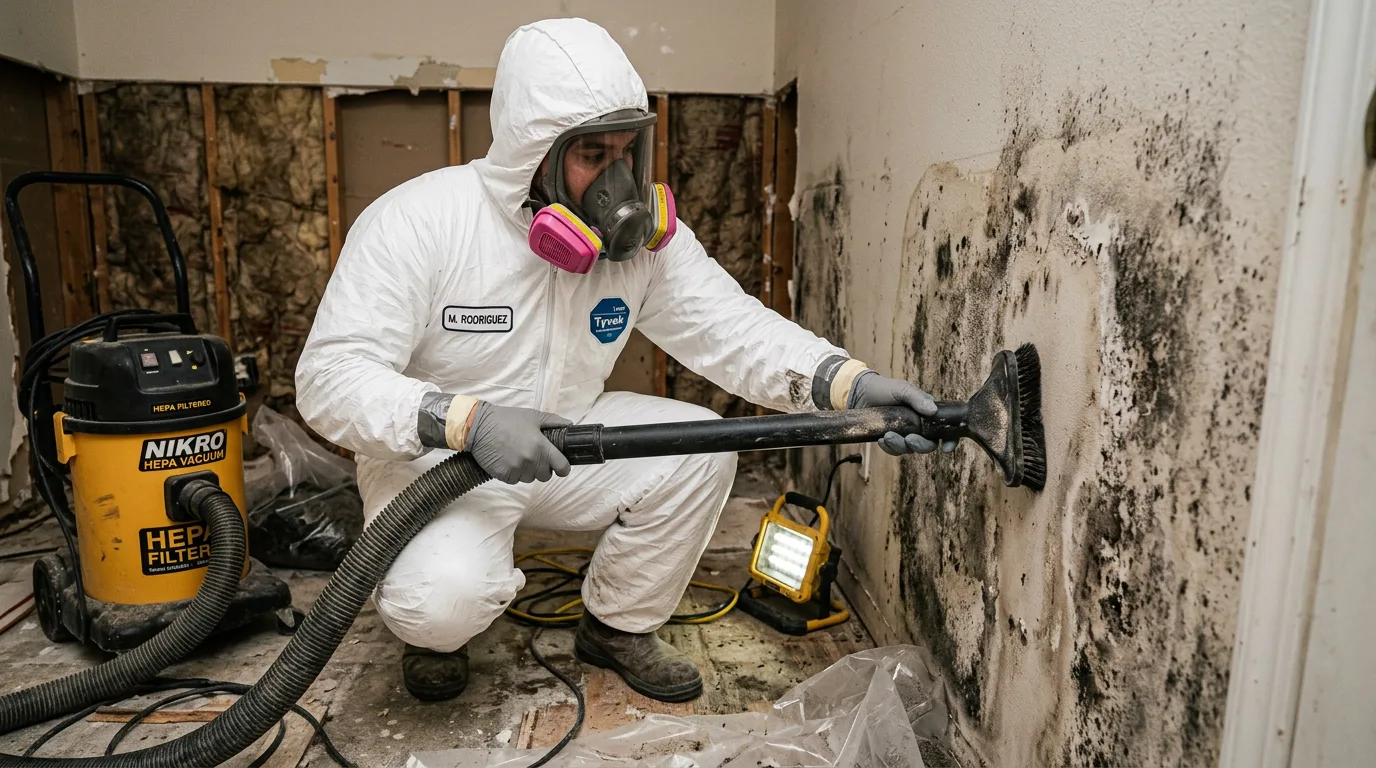
Mold remediation in Eagle Mountain, UT is one of the most misunderstood home restoration services — and one of the most important to get right. Homeowners often minimize visible mold (“it’s just a small patch in the corner”) or attempt DIY surface cleaning that addresses only what’s visible while leaving the underlying moisture source and the hidden mold colony intact. This guide explains the full mold remediation process for Eagle Mountain and Utah County homeowners — what triggers it, how it works, what post-remediation looks like, and how to prevent recurrence in Utah’s high-desert climate.
In this post, we cover mold biology and why Eagle Mountain’s conditions create risk, the IICRC S520 remediation protocol, what homeowners should expect during and after remediation, and the prevention strategies that work for Utah County’s specific climate and soil conditions.
Mold Found in Your Eagle Mountain Home? Start Here.
Free mold inspection, IICRC-certified remediation, independent clearance testing. Call (877) 698-1311.
Why Mold Matters in Eagle Mountain
Eagle Mountain’s semi-arid climate at roughly 4,800 feet elevation is generally not favorable to outdoor mold growth — lower average humidity means outdoor mold spore concentrations are lower than in humid coastal markets. This is sometimes misread as meaning Eagle Mountain homes are low mold risk. They are not.
Indoor mold is driven by localized moisture — specific wet surfaces inside the building envelope — not outdoor climate. Eagle Mountain homes generate indoor mold risk through the same mechanisms that create water damage risk: spring snowmelt, summer monsoon events, winter pipe bursts, and the ongoing vapor intrusion cycle driven by Utah County’s expansive clay soils. In the weeks following a spring flooding event in SilverLake or City Center, mold that began establishing in saturated insulation or wall cavities becomes visible on drywall surfaces — often in areas that weren’t obviously “wet” to the homeowner during the original event.
The 24–48 hour mold growth window is the key number. Mold spores present in every home’s air (at normal, harmless background levels) colonize wet organic material — drywall, insulation, wood framing, carpet padding — within 24–48 hours of the surface reaching sufficient moisture content. A water damage event that is addressed within this window, with proper extraction and drying, prevents mold. An event that sits for days before response has almost certainly created mold conditions in porous materials, even if nothing is yet visible.
IICRC S520: The Standard for Mold Remediation
The Institute of Inspection Cleaning and Restoration Certification (IICRC) Standard S520 governs mold remediation protocols. It establishes the minimum requirements that a professional mold remediation in Eagle Mountain must follow to produce a verifiably clean result:
1. Inspection and assessment: Comprehensive evaluation using moisture meters and thermal imaging to identify all current and historical moisture intrusion points. The assessment documents mold growth using visual inspection and, when indicated, surface sampling.
2. Containment: Polyethylene sheeting and negative air pressure are established around the affected area before any remediation activity begins. This prevents mold spores disturbed during removal from spreading to unaffected areas of the home.
3. Source control: The moisture source driving mold growth must be identified and addressed before remediation begins. This is the step most frequently skipped in inadequate remediation jobs — treating the mold without fixing the moisture guarantees recurrence.
4. Negative air and filtration: HEPA-filtered air scrubbers run throughout the remediation, capturing airborne spores generated during the removal process and preventing cross-contamination.
5. Material removal: All mold-contaminated porous materials are removed and double-bagged for disposal as regulated waste. Non-porous surfaces are HEPA-vacuumed and then cleaned with antimicrobial agents.
6. Post-remediation verification: An independent third-party air or surface sample confirms that mold levels in the remediated area match or fall below outdoor ambient levels before containment is removed.
Eagle Mountain Mold Remediation — Schedule Your Free Inspection
IICRC-certified team, independent clearance testing, all insurance accepted. Call (877) 698-1311.
Types of Mold Situations in Eagle Mountain Homes
Post-water-damage mold: The most common scenario — mold that developed following a water event that was not fully dried within the 24–48 hour window. Typically found in wall cavities, behind baseboards, in insulation, and under flooring adjacent to the original water intrusion area. May not be visible until weeks after the original event.
Crawl space and basement mold: Mold in crawl spaces and unfinished basements driven by Utah County clay soil vapor intrusion — not necessarily related to a discrete water event. Common in Eagle Mountain homes with vapor barrier deficiencies or crawl spaces that have experienced elevated moisture cycling from multiple seasons.
HVAC-distributed mold: Mold growing in HVAC components — coils, drain pans, ductwork — that distributes spores through the home’s air supply. Eagle Mountain homes with ducted forced-air systems that run through unconditioned attic or crawl space areas are at elevated risk for this scenario.
Attic mold: Inadequate attic ventilation combined with moisture from the living space (bathroom exhaust fans venting into the attic, air sealing deficiencies) creates conditions for mold on roof sheathing. Attic mold is common in Eagle Mountain’s newer construction and often discovered during roof inspections or during a sale.
Tile and grout mold: Surface mold in wet areas — showers, tubs, bathroom floors — that has penetrated behind tile through failed grout and caulk. When discolored grout is accompanied by soft or hollow-sounding tile, the mold and moisture have extended behind the tile face into the substrate.
What Post-Remediation Looks Like
After remediation is complete and clearance testing confirms successful results, the remediated area is ready for reconstruction. Reconstruction involves:
- Replacing removed drywall, insulation, and flooring
- Addressing the moisture source that caused the original mold (drainage correction, vapor barrier installation, plumbing repair)
- Any permit-required work in affected living spaces
Reconstruction following mold remediation in Eagle Mountain’s finished basement spaces — which is a common scenario given the prevalence of finished basement suites in Eagle Mountain neighborhoods — requires Eagle Mountain City building permits when the reconstruction affects living space. We handle permit coordination as part of every project.
Preventing Mold Recurrence in Eagle Mountain
- Address water damage within 24 hours — the single most effective mold prevention measure
- Maintain crawl space vapor barriers — inspect annually and repair any tears or displaced sections
- Control basement relative humidity below 60% — a dehumidifier that runs when indoor humidity exceeds 60% prevents the conditions mold needs to establish
- Verify HVAC drain pan function — clean and confirm drain pan flow annually
- Seal bathroom exhaust to exterior — confirm all bathroom exhaust fans discharge to the exterior, not into the attic
For the full restoration process following a mold event, see our Mold Remediation service page. For recognizing hidden water damage before it becomes a mold issue, see our 10 Signs of Hidden Water Damage guide.
Eagle Mountain Mold Remediation — Complete Process, Verified Results
Eagle Mountain Water Damage Restoration: IICRC-certified, independent clearance testing, all insurance accepted. (877) 698-1311.
Related: